A Defining Summit in Washington: Trump, Zelensky, and European Leaders Confront Ukraine’s Future
A high-stakes diplomatic gathering
Washington is hosting a pivotal summit today as U.S. President Donald Trump welcomes Ukrainian President Volodymyr Zelensky and a cohort of top European leaders to the White House. The meeting comes at a critical juncture, following Trump’s controversial encounter with Russian President Vladimir Putin in Alaska, and is widely seen as a test of Western unity in the face of Russia’s ongoing war against Ukraine.
The stated goal is to explore security guarantees for Kyiv and assess possible pathways toward a political settlement. Yet beneath the formal agenda lies a fragile balance between Western solidarity and the concessions Moscow continues to demand.
Who is at the table
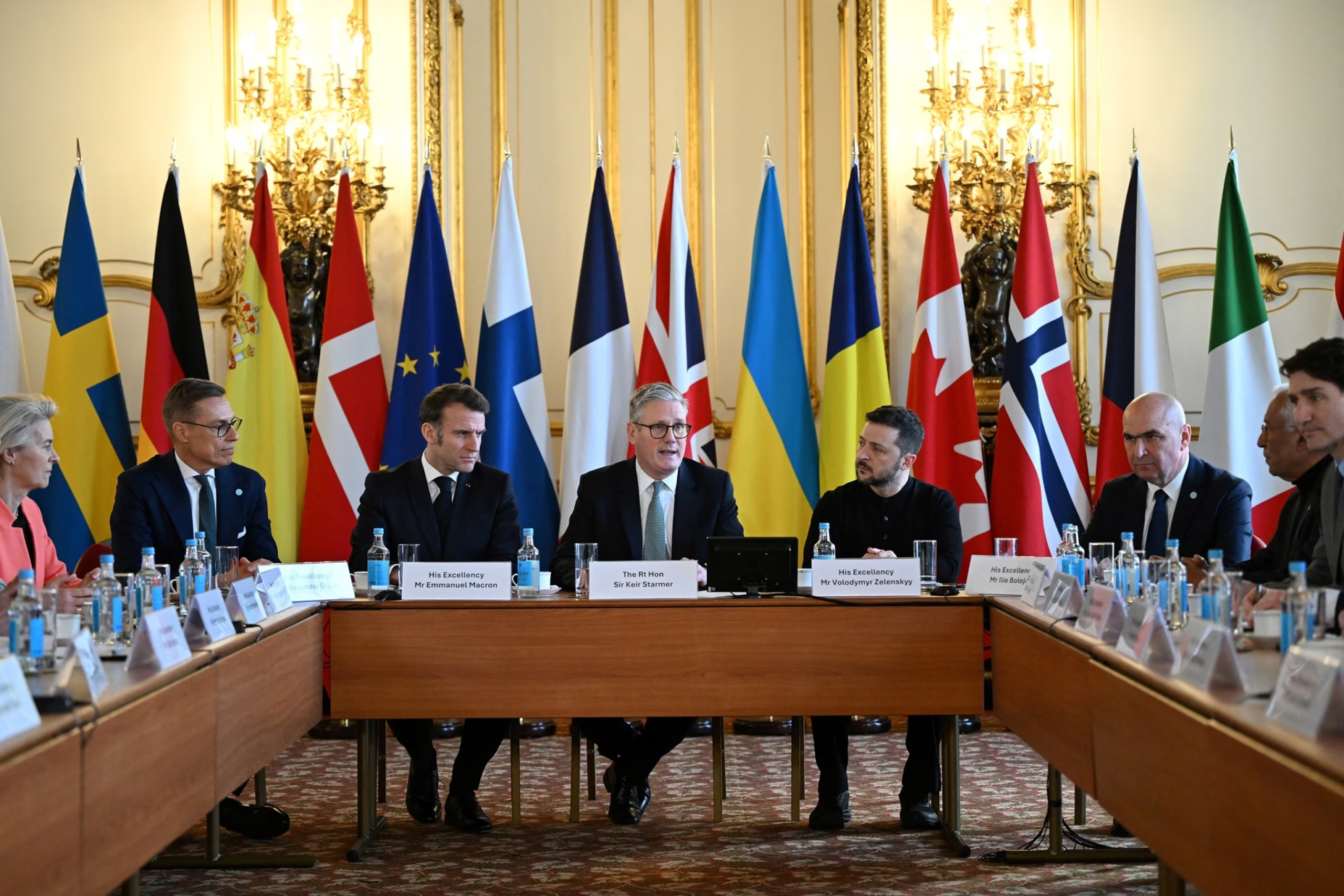
Alongside Trump and Zelensky, the summit brings together a formidable European delegation:
Ursula von der Leyen, President of the European Commission
Emmanuel Macron, President of France
Keir Starmer, Prime Minister of the United Kingdom
Friedrich Merz, Chancellor of Germany
Giorgia Meloni, Prime Minister of Italy
Alexander Stubb, President of Finland
Mark Rutte, NATO Secretary General
Their presence underscores Europe’s determination not to be sidelined in a process that could reshape the continent’s security architecture for decades to come.
Three key issues on the agenda
Security guarantees for Kyiv
Negotiators are weighing frameworks akin to NATO’s Article 5, though short of full membership. Such guarantees would rely on bilateral or multilateral commitments from the U.S. and European partners to deter further Russian aggression.The contentious question of territorial concessions
Trump has signaled that Ukraine should “move on” from Crimea and abandon its NATO ambitions — positions strongly opposed by Kyiv and many European capitals. Zelensky, with Western backing, is expected to push back, insisting that no durable peace can be achieved by legitimizing Russian annexations.Europe’s unity under strain
While European leaders aim to project a common stance, divisions remain. Some governments favor a rapid ceasefire to stabilize the continent, while others argue that premature concessions would embolden Moscow and undermine international law.
Stakes that go beyond Ukraine
This summit is not merely about Ukraine’s immediate future; it is a test of the West’s credibility in defending the post–Cold War order. For Europe, the challenge is to demonstrate both strategic cohesion and resilience at a moment when its security and economic stability are directly linked to the war’s outcome.
In Washington, the fate of Ukraine intersects with a broader question: how far are the United States and Europe willing to go to contain Russia’s influence — and at what cost?
The Trump–Zelensky–EU summit in Washington could mark a turning point in the war. A credible framework for security guarantees would strengthen Western leverage. But if the outcome leans toward territorial concessions imposed on Kyiv, it risks undermining Ukraine’s sovereignty and fracturing transatlantic unity.